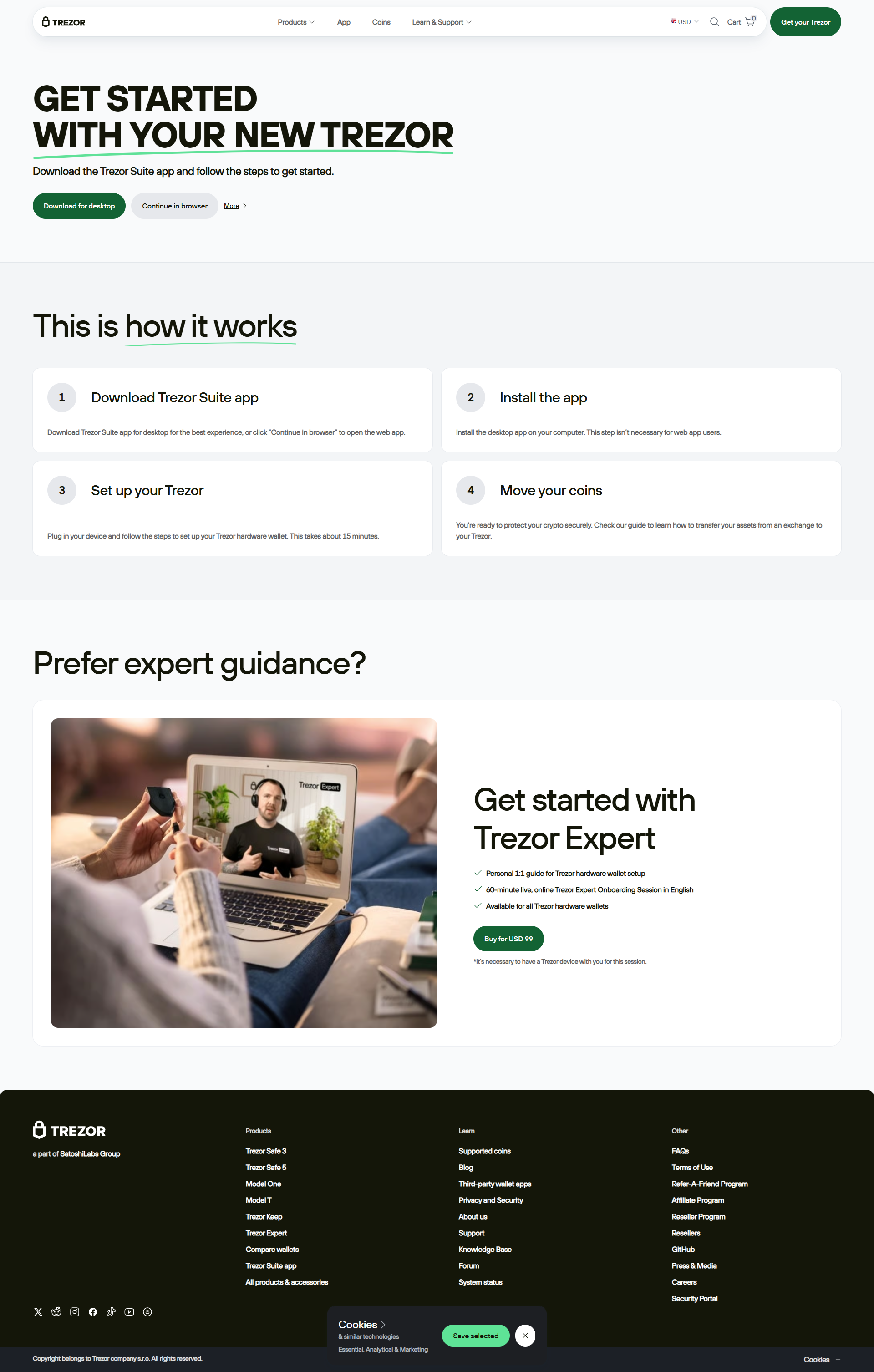
Trezor Login — How to Access & Protect Your Crypto Safely
A practical, beginner-to-intermediate guide to logging into Trezor devices, understanding seed security, and using the Trezor Suite to manage assets, DeFi, and NFTs without exposing your private keys.
What “Trezor Login” Actually Means
Trezor login is the process of connecting your Trezor hardware wallet (Trezor Model T or Trezor One) to the Trezor Suite application or compatible web apps, authenticating actions via the device, and signing transactions. It’s not a username/password on a server — authentication happens on-device. When you 'log in' with Trezor, you unlock the hardware (usually with a PIN), confirm operations on the device screen, and keep your private keys isolated in the device’s secure enclave.
This model provides cold storage protection: the seed phrase (recovery phrase) and private keys never leave your physical wallet, drastically reducing phishing, keylogger, and remote-hack risks.
Step-by-Step: How to Perform a Trezor Login
1. Install Trezor Suite
Download the official Trezor Suite from Trezor’s website. Avoid third-party downloads or links in unverified messages.
2. Connect Your Trezor
Plug the device into your computer via USB (or use a verified OTG for mobile). Unlock it with your PIN.
3. Open Trezor Suite
Trezor Suite will detect your device and prompt to unlock and sync your accounts.
4. Confirm On-Device
Every transaction, address check, or settings change must be confirmed using the physical buttons on your Trezor — that is the core of Trezor login security.
Trezor Login Security Features
- PIN protection — Thwarts local attackers and keyloggers.
- Physical confirmation — Transactions need on-device approval.
- Recovery seed — 12/24-word mnemonic stored only on paper at setup.
- Passphrase (optional) — Adds a highly secure, user-defined layer (acts as an extra word).
- Open-source firmware — Public audits increase transparency and trust.
Common Login Mistakes & How to Avoid Them
- Downloading suite from unverified links — always use trezor.io.
- Entering recovery phrase on any website — never do this.
- Using weak passphrases or storing seed digitally — keep seed offline on paper/metal.
- Skipping firmware updates — keep them current for security patches.
Trezor Suite Walkthrough: After Login
Trezor Suite is the desktop and web application that functions as the user interface for accounts, transaction history, market data, and advanced features like coin control and coinjoin support (for privacy coins).
Accounts & Balances
Add currency accounts (BTC, ETH, etc.) and view balances and transaction history.
Send & Receive
Create a transaction, verify the address on-device, and sign to broadcast.
Apps & Integrations
Connect to wallets, DeFi platforms, and NFT marketplaces that support Trezor.
Advanced Settings
Set passphrase rules, backup checks, and privacy features within Suite.
Quick Comparison — Trezor Login vs. Exchange / Hot Wallet Login
| Feature | Trezor Login | Exchange / Hot Wallet |
|---|---|---|
| Key storage | Offline (hardware) | Online (server or browser) |
| Authentication | PIN + on-device confirmation | Password + 2FA (software) |
| Phishing risk | Low (device address checks) | High (credential theft) |
| Control of assets | User has full custody | Often custodial (exchange holds keys) |
Practical Scenarios — When to Use Trezor Login
Use Trezor login for:
- Long-term cold storage for high-value holdings (HODL strategy).
- Interacting with DeFi or signing high-value transactions with on-device verification.
- Managing multiple accounts across chains while keeping a single secure seed.
- Accessing NFTs and signing marketplace operations securely.
Quote
“Trezor login changes the threat model: instead of protecting keys online, you protect the hardware. That flips the attacker’s calculus.” — Privacy & Security Researcher
FAQ — Trezor Login (Most Asked Questions)
Q: Can I log into Trezor Suite without the device?
A: You can open Trezor Suite to view help or market data, but to access accounts and sign transactions you must connect and unlock your Trezor hardware.
Q: What happens if I lose my Trezor?
A: Restore your wallet on a new Trezor using the seed phrase you wrote down during setup. If you used a passphrase, you must remember it or you cannot access those particular derived accounts.
Q: Is the Trezor firmware open-source?
A: Yes. Trezor’s firmware and much of their codebase are open-source and audited by community researchers — this improves transparency and trust.
Q: Are there fees to use Trezor?
A: Trezor Suite is free. Blockchain transaction fees still apply when sending assets, and third-party services (swap providers, exchanges) may charge fees.
Final Checklist — Before You Log In
- Download Trezor Suite only from trezor.io.
- Verify firmware authenticity and enable device genuine checks.
- Write your recovery seed on paper/metal and store offline in two secure locations.
- Consider using a strong, memorable passphrase (if you understand recovery complexity).
- Keep software and firmware updated; never share your seed or passphrase electronically.
Trezor Login — Secure Access, True Ownership
By making the Trezor login process part of your routine — verify, connect, confirm on-device — you ensure that your private keys remain untouchable. Use PINs, seeds, and optional passphrases wisely, and Trezor will keep giving you a powerful combination of usability and strong security for years to come.